Hedge funds pool capital from wholesale investors and deploy it across long and short positions, leverage and multiple asset classes. Industry capital reached a record US$5.6 trillion in the second quarter of 2026. Equity hedge led returns in 2025; macro was the weakest of the four main strategy groups.
A hedge fund is pooled capital managed with a wider mandate than a traditional fund, allowing the manager to take long and short positions, use derivatives, and move across asset classes as conditions change.
This guide covers the strategies, structures, fees, and risks that determine hedge fund performance, and what each of the main strategy groups actually did over the past two years.
The Fundamentals of Hedge Funds Explained
What Is a Hedge Fund?

A hedge fund is a private investment fund that pools capital from a limited number of wholesale or sophisticated investors and deploys it across a wide range of investment strategies. It is not available to the general public and is subject to less regulatory disclosure than a retail managed fund.
Depending on the mandate, managers use long/short equity, global macro, event-driven, relative value, multi-strategy, or quantitative and systematic approaches, across equities, bonds, currencies, commodities and derivatives.
How Large Is the Hedge Fund Industry?
Total hedge fund industry capital reached a record US$5.6 trillion at the end of the second quarter of 2026, according to Hedge Fund Research. The quarter added US$409.3 billion, the largest quarterly increase in the industry’s history, of which US$364 billion came from performance and US$45.2 billion from net inflows.
Asset gains by strategy over the quarter: equity hedge added US$173 billion, event-driven US$145 billion, and relative value US$55.1 billion.
How Do Hedge Funds Make Money?
Hedge funds charge a management fee calculated on assets under management and a performance fee tied to investment gains. The traditional arrangement is described as “2 and 20,” though that reference point no longer describes market practice. The most recent granular survey data put the mean management fee at 1.4% and the median at roughly 1.25%, with more than half of funds charging 1.5% or less. Around 69% of active funds cite a 20% performance fee.
Institutional investors have pushed managers for lower fees, clearer expense reporting, and closer alignment between compensation and performance. Performance hurdles, clawback provisions and pass-through fee models at large multi-strategy funds have all become more common.
How Do Hedge Funds Work?
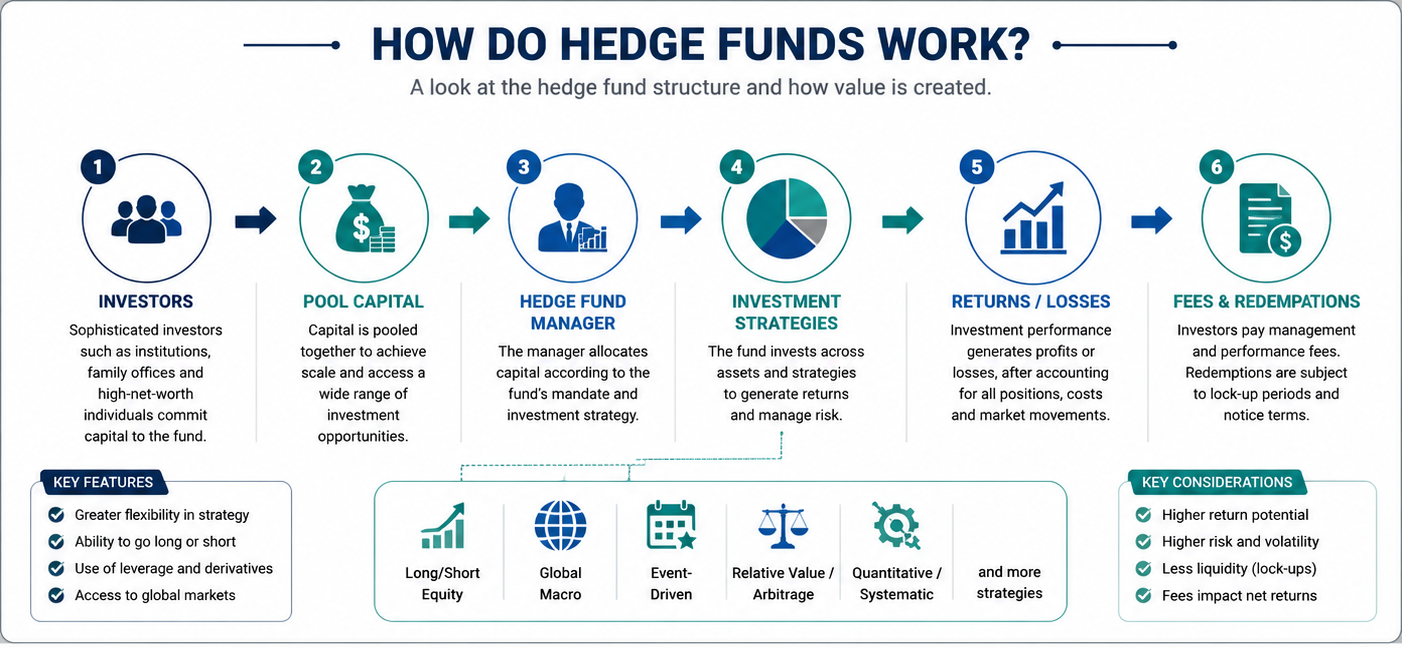
Pooled Capital
Investors allocate capital to a fund overseen by a general partner or investment manager. In Australia, hedge funds are generally available only to wholesale investors as defined under the Corporations Act 2001, who must satisfy net asset, income, or professional investor tests.
Broad Investment Mandate
A traditional equity fund can only buy shares. A hedge fund can take long and short positions, use leverage, invest across multiple asset classes simultaneously, and employ derivatives. That mandate width is the defining feature of the structure.
Lock-Up Periods
Most hedge funds impose lock-up periods, often a year or more, during which investors cannot withdraw capital. Redemption windows after the lock-up are limited to set intervals, typically quarterly or semi-annually. The illiquidity is the trade-off for strategies that require patient capital.
Fee Structure
Investors pay an annual management fee regardless of performance, plus a share of profits above a hurdle rate. Many funds apply a high watermark, so investors pay performance fees only on net new profits, and the fund cannot charge twice for recovering ground it previously lost.
The Core Hedge Fund Strategies for Investors
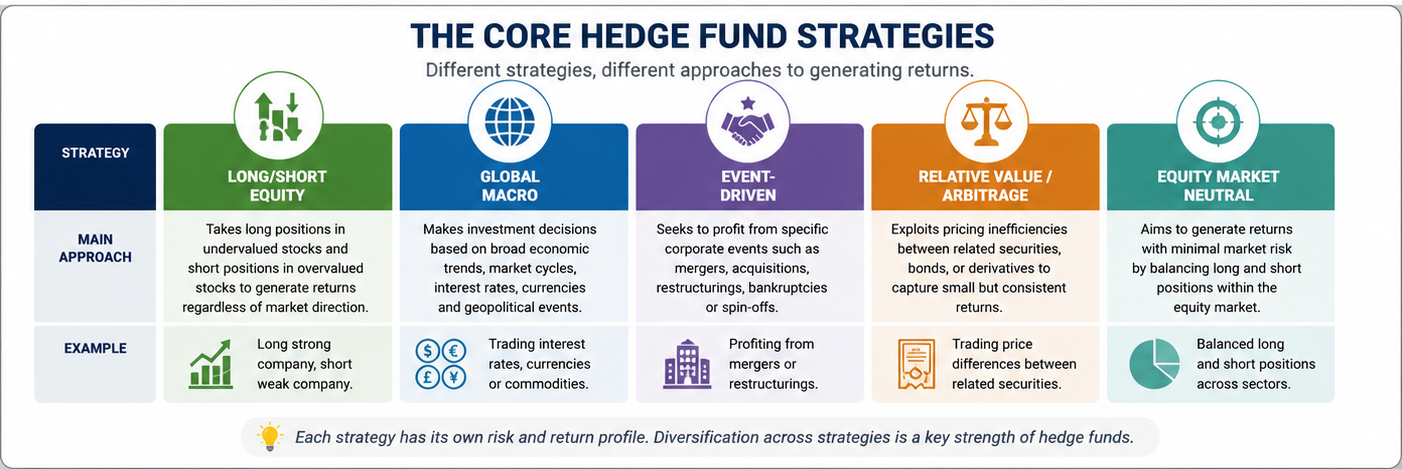
Long/Short Equity
The most widely used strategy and the largest by assets under management. Managers buy stocks they consider undervalued and sell short stocks they consider overvalued, aiming to profit from relative performance while reducing exposure to overall market direction.
Global Macro
Macro funds take positions based on economic trends across countries and asset classes, including interest rate cycles, currency movements, geopolitical shifts and central bank policy. A macro fund anticipating rising inflation might short government bonds and go long commodities. These funds hold positions across equities, currencies, bonds and derivatives simultaneously.
Event-Driven
Event-driven strategies target corporate events: mergers, acquisitions, restructurings and spin-offs. Merger arbitrage, a sub-strategy, involves buying the target company’s shares in an announced deal and selling the acquirer, capturing the gap between the current price and the acquisition price.
Relative Value/Arbitrage
Relative value funds target pricing discrepancies between related securities. Statistical arbitrage uses quantitative models and high-frequency execution to exploit small inefficiencies across large numbers of positions.
Equity Market Neutral
A variant of long/short equity where the fund holds roughly equal long and short exposure, seeking to remove market risk entirely and profit from stock selection alone.
Rivkin Private Wealth provides wholesale investors with access to curated alternative strategies, including long/short equity funds. Contact us for details.
Recent Performance
The HFRI Fund Weighted Composite returned 12.6% in 2025, its strongest calendar year since 2009. The dispersion between strategies was wide.
| Strategy | 2025 return |
| Equity Hedge | 17.3% |
| Event-Driven | 11.0% |
| Relative Value | 7.5% |
| Macro | 7.2% |
Equity hedge led, driven by healthcare at 33.8%, its strongest year since inception, and energy and basic materials at 23.4%. Macro was the weakest of the four main strategy groups, which is the reverse of how the period is often described.
2026 has run differently. The HFRI Fund Weighted Composite was up 6.2% year to date through July, with July itself down 1.1%. HFRI Technology fell 7.0% in July on AI weakness, its worst month since January 2008, and Fundamental Growth fell 4.2%. Macro Commodity, up 2.2%, and Relative Value Yield Alternatives, up 2.1%, led that month.
The Risks
Hedge funds carry risks that differ from traditional managed funds.
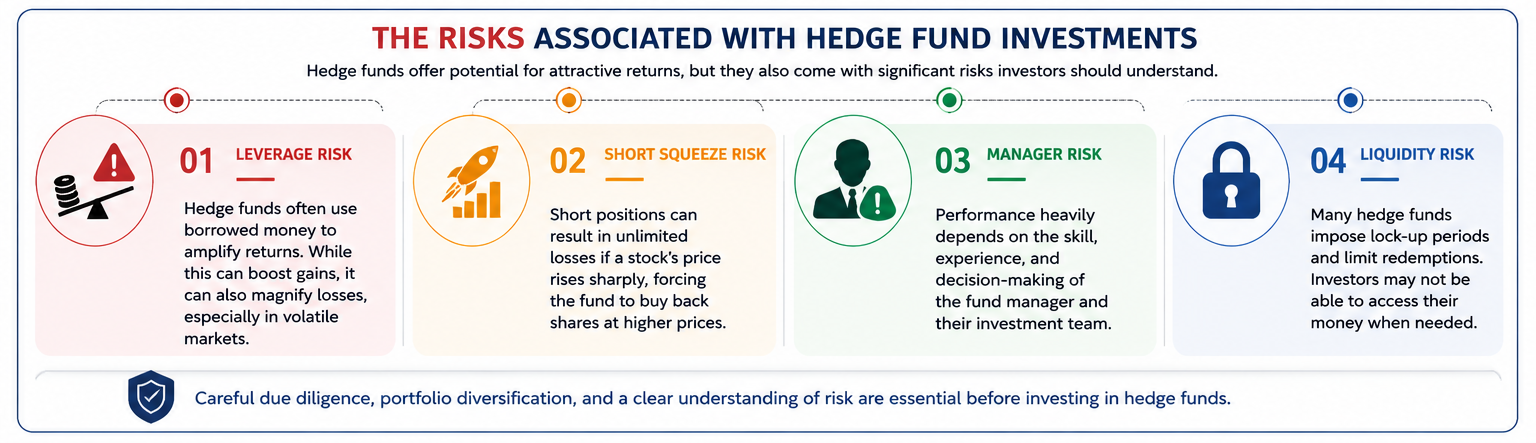
Leverage Risk
Many strategies use borrowed capital to amplify returns. Leverage magnifies gains and losses equally, so a leveraged fund can suffer outsized losses when positions move against it.
Short Squeeze Risk
Short positions carry theoretically unlimited loss potential. When a heavily shorted stock rises sharply, as GameStop did in 2021, funds holding large short positions face escalating losses as they cover.
Manager Risk
Hedge fund returns depend on the manager’s decisions rather than on a rule-based benchmark. The 2025 spread between equity hedge at 17.3% and macro at 7.2% shows the strategy-level dispersion; manager-level dispersion within each strategy is wider again.
Liquidity Risk
Lock-up periods and limited redemption windows mean investors cannot access capital on demand. In periods of market stress, some funds have suspended redemptions entirely.
Frequently Asked Questions
Who can invest in hedge funds in Australia?
Wholesale investors under the Corporations Act 2001. That requires meeting a net asset threshold of $2.5 million or gross income of $250,000 in each of the last two financial years, certified by a qualified accountant, paying at least $500,000 for the product, or qualifying as a professional investor.
Are hedge funds better than managed funds?
They serve different purposes. A hedge fund’s value depends on whether its strategy adds diversification or return the rest of the portfolio does not already provide.
Have hedge funds performed well recently?
2025 was the industry’s strongest calendar year since 2009, at 12.6% on the HFRI Fund Weighted Composite, led by equity hedge at 17.3%. 2026 has been more mixed, at 6.2% through July, with a negative July driven by technology exposure.
Is “2 and 20” still accurate?
As a description of current practice, no. Survey data puts mean management fees at around 1.4% and median at roughly 1.25%, with 20% remaining the common performance fee. Large multi-strategy funds increasingly use pass-through expense models instead.
Conclusion
Hedge funds occupy a specific role in institutional and wholesale portfolios, sitting alongside equity and bond allocations. The strategies range from equity-focused to macro to arbitrage, and the 2025 spread between the best and worst performing groups was ten percentage points.
Strategy selection and manager selection carry more weight in this asset class than in most others, and the fee structure means both matter to the net return.
Rivkin Private Wealth provides wholesale investors with access to curated alternative strategies. Contact us for details.