Venture capital funds early-stage, high-growth companies in exchange for equity. It is a high-risk private market segment with a long holding period and a return distribution concentrated in a small number of outcomes. Access in Australia is generally restricted to wholesale investors.
Airbnb, Canva, Afterpay and Atlassian were all early-stage businesses that needed capital before they generated the profits that made them attractive to public markets. Venture capital provides that capital, and the investors who provide it are pricing what a company might become rather than what it currently earns.
This guide covers how venture capital works, who can access it in Australia, and what it requires of an investor.
What Is Venture Capital Investing and Who Can Access It?
The Core Concept of Venture Capital Explained
Venture capital is a form of private equity focused on early-stage, high-growth companies. VC funds pool money from institutional investors, family offices, and wholesale investors, and deploy it into startups and growing businesses in exchange for equity.
Venture capital differs from the rest of private equity in three respects. Buyout funds acquire majority stakes in mature companies and use significant leverage. VC funds take minority stakes in early-stage businesses, provide follow-on capital across multiple rounds as the company grows, and accept that many investments will fail entirely in exchange for the prospect of a small number of large winners.
Who Can Access Venture Capital in Australia?
Direct participation in venture capital funds is generally restricted to wholesale investors as defined under section 708 of the Corporations Act 2001. Under the sophisticated investor test, a person qualifies where a qualified accountant certifies, within the preceding six months, that they meet the thresholds in the Corporations Regulations 2001. Regulation 6D.2.03 sets those at net assets of $2.5 million or more, or gross income of $250,000 or more in each of the last two financial years.
A person also qualifies by paying at least $500,000 for the securities on acceptance of the offer, a figure set in section 708(8) itself. A separate limb, section 708(11)(b), covers a person who has or controls gross assets of at least $10 million, including assets held by an associate or under a trust the person manages.
These thresholds have not changed since 2001. The Parliamentary Joint Committee on Corporations and Financial Services reported in February 2025 that a case for raising them had not been established, and recommended a periodic review mechanism and the removal of subjective elements from the test rather than a change to the dollar figures. No government response has been published, and no change is before Parliament as at September 2026.
Wholesale status grants access to venture capital deals, private equity rounds, pre-IPO placements and alternative funds not offered to retail investors. Offers to wholesale investors are not required to include a disclosure document, on the basis that these investors can evaluate opportunities without retail regulatory protections.
Two government programs provide tax concessions for venture capital. The Venture Capital Limited Partnership regime gives flow-through treatment, a CGT exemption for eligible foreign limited partners, and capital account treatment of the general partner’s carried interest. The Early Stage Venture Capital Limited Partnership regime exempts investors from income tax and CGT on income and gains from eligible venture capital investments, and provides limited partners a non-refundable carry-forward tax offset of up to 10% of eligible contributions. The 2026-27 Budget announced increases to the investee asset caps and ESVCLP fund size limits, effective 1 July 2027 and subject to legislation.
The Risk and Return Profile of Venture Capital in Australia
Venture capital carries the highest risk of the major asset classes. Experienced VC investors expect most investments in any fund to return little or nothing, with a small number of exceptional performers generating the fund’s return.
That distribution is the defining feature of the asset class. A single investment returning 100 times invested capital offsets a dozen that returned zero. It is also why venture capital requires a long horizon and tolerance for individual failures.
Investing in an unlisted company generally means a commitment of four to six years. Investors who may need liquidity inside that window should not allocate to venture capital. The illiquidity is structural.
The Rivkin Report provides independent analysis across listed and private markets. Read the latest report.
How Does Venture Capital Work?
Fund Formation
Venture capital funds are typically structured as limited partnerships, which separates the people who manage the money from the people who provide it. The venture capital firm is the general partner, responsible for sourcing companies, negotiating terms and managing the portfolio. The investors who supply the capital, including institutions, family offices and wholesale investors, are the limited partners. They commit capital upfront and leave investment decisions to the general partner.
Once raised, the general partner deploys the capital over a defined investment period, usually the fund’s first three to five years. The fund itself typically runs for around ten years, which allows time for portfolio companies to mature before the fund sells down. Investments made in the early years are generally exited between years four and ten, once the businesses can be sold, listed, or acquired.
Deal Sourcing and Due Diligence
The investment process starts with an initial screen against the fund’s criteria. Opportunities that pass proceed to a meeting with the founding team and a review of the business plan, then to due diligence covering the market opportunity, business model, financials, team, competitive position and legal structure.
Investment Stages
Venture capital investments are typically categorised by the following stages:
- Seed stage: Capital for the earliest-stage companies, often pre-revenue, to develop a prototype or prove a concept. Typically provided by family, friends, university funds or angel investors in exchange for equity. Highest risk and highest potential return.
- Series A: The first institutional round, targeting companies that have demonstrated product-market fit and are ready to scale. Provided by VC firms following formal due diligence.
- Series B: Capital to meet new levels of demand or expand into new markets.
- Series C and beyond: Larger amounts deployed once the business has proven itself, used to accelerate growth or build scale ahead of an eventual listing.
The Exit
VC funds generate returns for their investors when portfolio companies are exited. The timing and price of the exit determine the return. Investments are typically held for four to six years before exit.
| Exit Route | How It Works |
| IPO | The company lists on a public exchange, allowing the fund to sell its shares on the market. |
| Trade Sale | A strategic buyer, often a larger company in the same or an adjacent industry, acquires the business outright. |
| Secondary Sale | The fund sells its shares to another investor, such as a later-stage fund or private equity buyer, rather than waiting for a listing or acquisition. |
The Fee Structure
VC funds typically charge a management fee of around 2% on committed capital and carried interest of around 20% of profits above a hurdle rate, commonly 8%. Management fees apply regardless of how individual investments perform. Fee levels compress at larger fund sizes.
The Australian VC Ecosystem in 2026
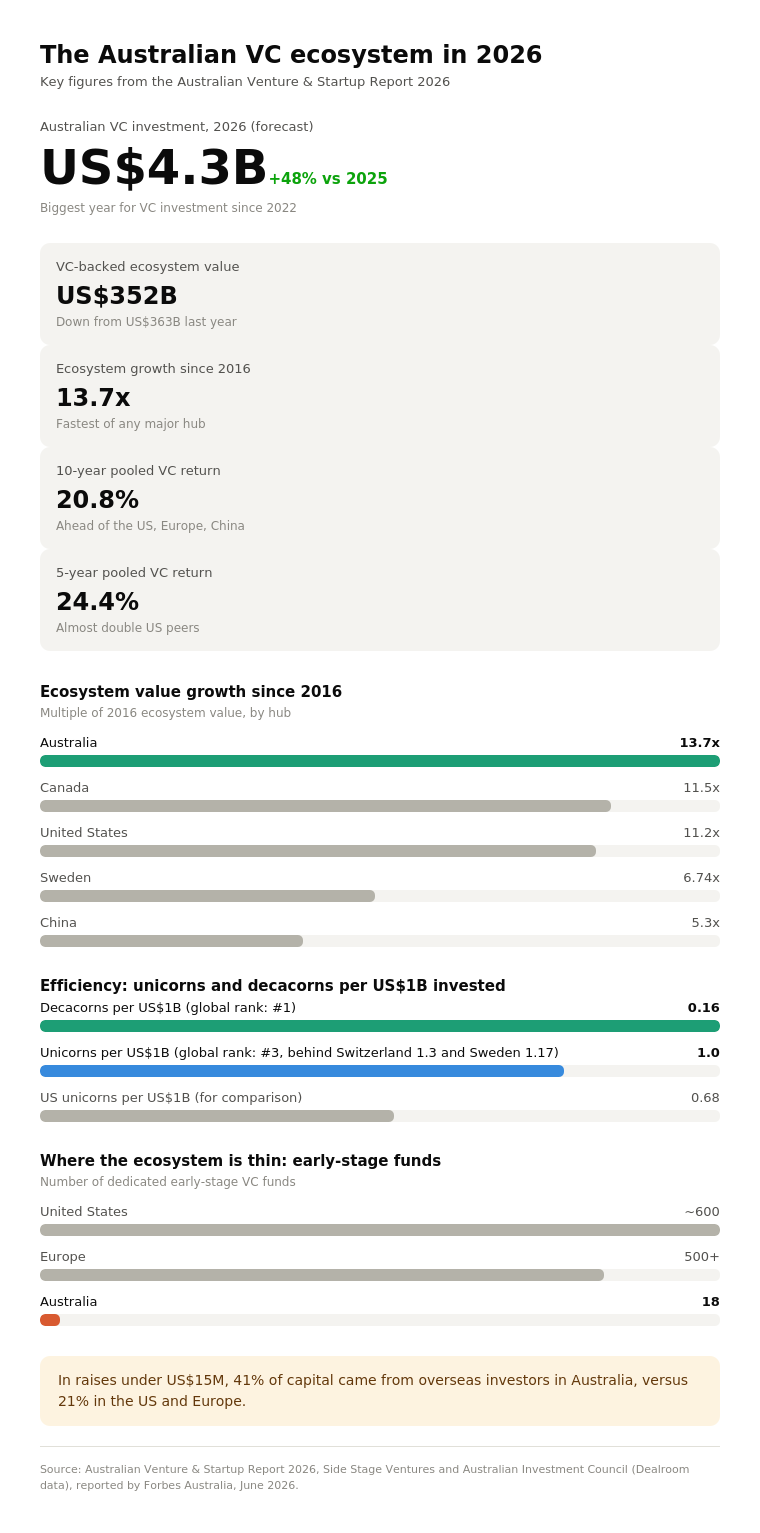
The Australia Venture and Startup Report 2026, produced by Side Stage Ventures with Dealroom and the Australian Investment Council, forecasts Australian VC investment of US$4.3 billion in 2026, up 48% on 2025 and the strongest year since 2022. Cut Through Venture, which uses a different methodology and reports in Australian dollars, recorded A$5.4 billion across 390 deals in 2025 and A$3.5 billion in the first half of 2026, the second-strongest start to a year on record.
Dealroom puts the combined enterprise value of Australia’s VC-backed ecosystem at US$352 billion, down from US$363 billion a year earlier on the back of a fall in Atlassian’s market capitalisation. Ecosystem value has grown 13.7 times since 2016, which the report describes as faster than any other major global hub. Australian VC funds delivered a five-year pooled return of 24.4%, close to double the equivalent figure for US funds. Australia also ranks first globally for decacorns produced per dollar invested and third for unicorn efficiency, behind Switzerland and Sweden.
Early-stage funding is the weak point. Australia has 18 funds doing five or more seed deals a year, against more than 500 in Europe and around 600 in the United States. Overseas investors supply 41% of early-stage capital in Australia, roughly double the 21% share in the US and Europe, which means international capital is filling the gap local early-stage funds have left.
Frequently Asked Questions
What is the difference between venture capital and private equity?
Venture capital is a branch of private equity focused on early-stage, high-growth companies. Traditional private equity acquires majority positions in established firms, often using leverage. VC takes minority stakes in young businesses and accepts a higher failure rate in exchange for the prospect of outsized returns on a small number of holdings.
What returns can VC investors realistically expect?
Returns vary by fund vintage, manager, and sector. Top-quartile VC funds have achieved net IRRs of 20% to 30% or higher over extended periods, while median fund performance is considerably lower. The distribution is skewed, with a small number of funds producing most of the industry’s returns.
How do I access venture capital as an Australian wholesale investor?
Through managed VC funds, direct co-investment alongside established VC firms, or platforms that connect wholesale investors with private market opportunities. Take professional advice before committing capital to any VC vehicle.
How is venture capital taxed in Australia?
Investments made through qualifying VCLP or ESVCLP structures can access CGT exemptions on gains from qualifying investments, with the ESVCLP concessions extending to Australian limited partners and the VCLP exemption applying to eligible foreign limited partners. Income from VC funds is otherwise taxed at the investor’s marginal rate. Outcomes depend on the fund structure and the investor’s circumstances.
Is there a minimum investment for VC funds?
Minimums vary. Institutional VC funds often require commitments of $500,000 to $1 million or more. Some wholesale platforms set lower minimums. The minimum is a practical constraint; illiquidity and the holding period are the substantive suitability considerations.
Conclusion
Venture capital supplies capital to companies at the point where their outcomes are least certain, in exchange for equity that may compound at rates listed markets do not offer. It suits wholesale investors with a long horizon, tolerance for individual failures, and an allocation sized so that illiquidity does not create a problem elsewhere in the portfolio.
The Australian ecosystem is growing faster than any comparable hub on Dealroom’s measure, and its early-stage funding base remains thin by international standards. Both facts matter to anyone sizing an allocation.
The Rivkin Report conducts independent research across private and public markets for self-directed investors. Read the latest market updates.